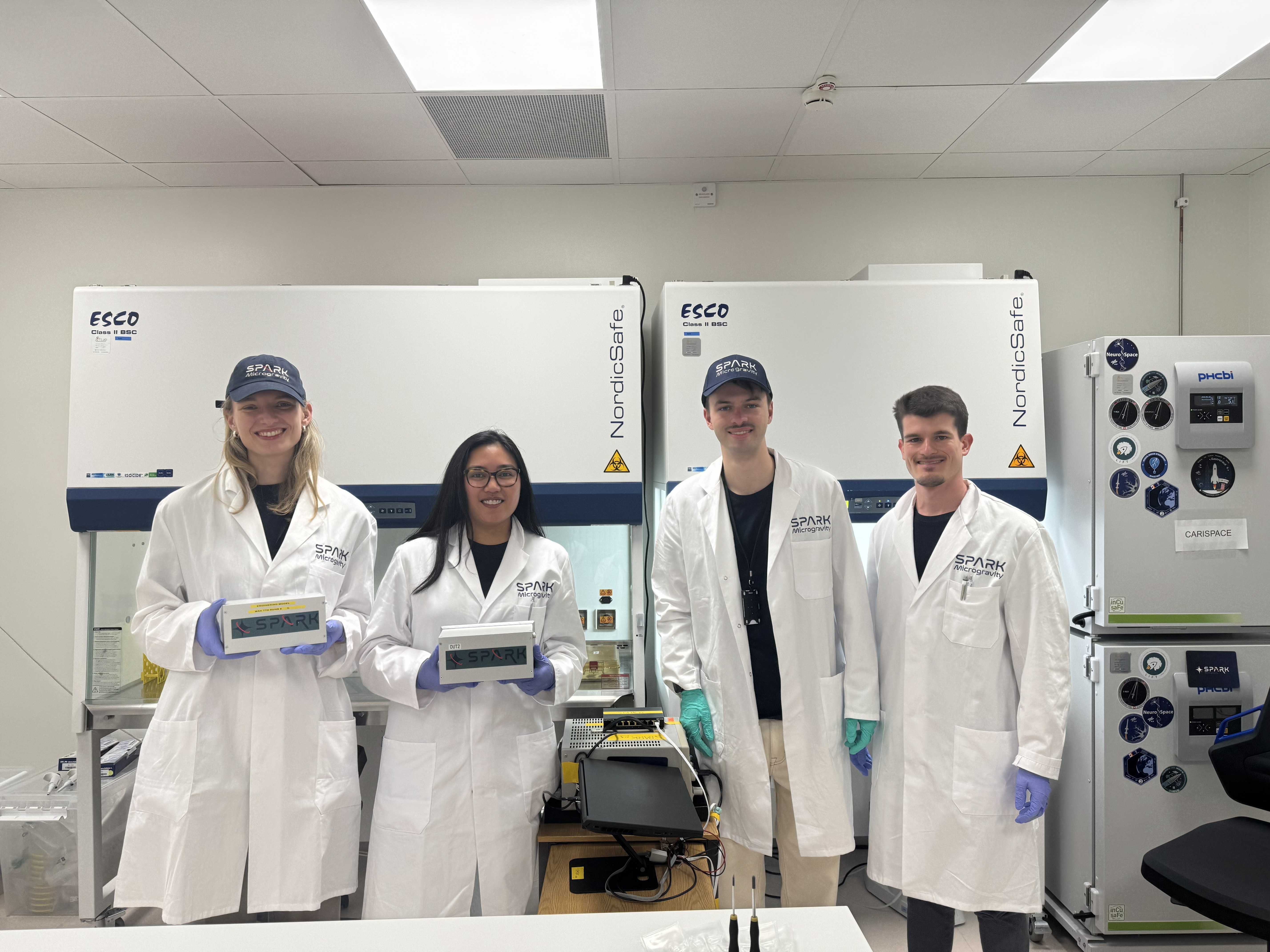
SPARK Microgravity Completes First Rocket Launch, Marking a Major Milestone Toward Orbital Cancer Research
SPARK Microgravity Completes First Rocket Launch, Marking a Major Milestone Toward Orbital Cancer Research


Author: Kelly Soverns
Cancer touches nearly every family, and the sentiment that “cancer sucks” resonates universally.At the World Economic Forum in Davos this week, two leaders from SPARK Microgravity GmbH made the case that the path to better cancer treatments may run through outer space.
Speaking at the Frontiers Science House in Davos, SPARK Microgravity CEO Allison Bajet and COOKatharina Weidmann outlined how their company’s Orbital Cancer Lab is leveraging microgravity to study cancer in ways impossible on Earth. Their message was blunt: despite decades of research,“of the 200‑plus cancer types, only a few are truly curable,” Weidmann told attendees. To change that, SPARK Microgravity is looking upward.
Why Space?
In microgravity, cancer cells behave more naturally. Freed from Earth’s gravitational pull, cells form three‑dimensional structures that mimic how tumors grow inside the body. On Earth, by contrast,cells flatten into two‑dimensional layers, distorted by mechanical stress and gravity. That distortionlimits scientists’ ability to observe how cancer develops and responds to treatment.
The consequences are stark. Roughly 90% of oncology drug candidates fail in clinical trials, Bajet noted, in part because early‑stage research relies on models that don’t accurately reflect humanbiology.
By studying cancer in orbit, SPARK Microgravity researchers aim to generate higher‑fidelity datathat can feed advanced AI models, improve genomic sequencing, and accelerate the development of personalized mRNA and chemotherapy. The ambition is to reduce today’s costly trial-and-error approach and move toward more targeted, patient-specific therapies.
Their work pulls commercial spaceflight into the heart of life sciences and data-driven medicine, expanding what we mean by “the space economy” in the process.
“We Want to Cure Cancer in Space”
Bajet did not mince words. “We’re not being subtle about this. We want to cure cancer in space. We are building this orbital cancer lab to bring hope to cancer patients on Earth” she said.
Early results from SPARK Microgravity’s experiments are promising, but the team emphasizes thatmore research is needed. Their work has already moved beyond theory: the Orbital Cancer Lab hasflown multiple missions aboard the International Space Station, with additional launches delivered and planned through commercial rideshare partners including Axiom, Voyager, ATMOS SpaceCargo, Sweden Space Corporation (SSC), and France’s HyprSpace.
A Call for Global Collaboration
Bajet and Weidmann closed their Davos presentation with an appeal to scientists, investors, and policymakers. Advancing orbital cancer research will require collective navigation of complexi nternational regulations and securing sustained support for innovation.
“Join the revolution,” Weidmann urged. Cancer, she reminded the audience, “does not knowborders.” As a takeaway, the researchers want everyone to remember their motto: “Spark labs inspace, cures on Earth.”
About the Frontiers Science House in Davos
Frontiers’ Chief Executive Editor Frederick Fenter emphasized that the venue was designed toplace emerging scientific priorities directly before industry and government leaders, acceleratingattention to research addressing global health and environmental challenges. He expressed hopethat the conversations there would elevate the importance of emerging scientific study and ensurekey research receives stronger attention and commitment from the leaders and experts broughttogether for the World Economic Forum.
SPARK Microgravity Completes First Rocket Launch, Marking a Major Milestone Toward Orbital Cancer Research

SPARK Microgravity’s leadership engaged with partners including Atmos Space Cargo, Space Cargo Unlimited, and Merck Sharp & Dohme (MSD)
.svg)


From orbit to clinic, let’s launch the future of healthcare, together.