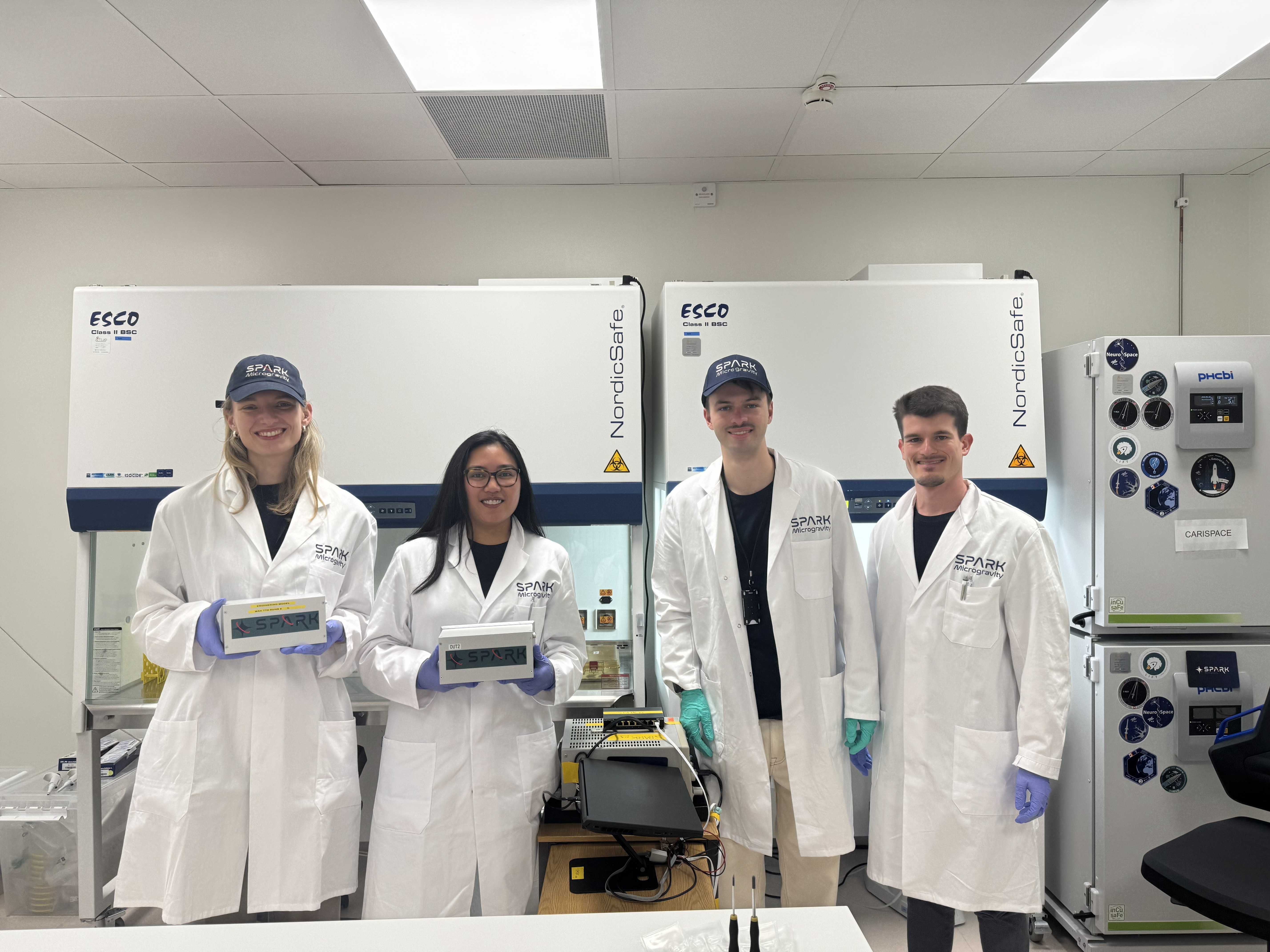
SPARK Microgravity Completes First Rocket Launch, Marking a Major Milestone Toward Orbital Cancer Research
SPARK Microgravity Completes First Rocket Launch, Marking a Major Milestone Toward Orbital Cancer Research


With terrestrial biotech advancing at a record pace, some question the need for orbital R&D. But microgravity isn't a substitute for Earth-based tools—it's a unique amplifier that overcomes their fundamental limits.
TL;DR: The Executive Summary
The biotech world is experiencing a golden age. Organoids—miniature, lab-grown organs—are revolutionizing drug screening with patient-specific 3D models. The global vaccine market, supercharged by mRNA technology, is projected to exceed $150 billion by 2033. With such powerful tools at our disposal on the ground, it’s a fair question to ask: is sending cancer cells to space still necessary?
Skeptics argue that the cost and complexity of orbital research are unjustified when terrestrial platforms are advancing so quickly. If we can create personalized "tumors-in-a-dish" and design vaccines at record speed, what unique value does a microgravity lab truly offer? It's a logical point, but one that overlooks the fundamental physical limitations that even our most advanced Earth-based systems cannot escape.
Terrestrial biotech is undeniably powerful. Organoids provide a far more relevant model than flat cell cultures, capturing patient-specific genetics and 3D architecture. Likewise, modern mRNA platforms have accelerated vaccine development from years to months. These technologies have dramatically improved preclinical research.
However, they are not without limits. Every experiment conducted on Earth is subject to the constant, distorting force of gravity. For organoids, this means they often struggle with:
These limitations aren't minor details; they are confounding variables that contribute to the 90%+ failure rate of oncology drugs in clinical trials. Our Earth-based models are good, but they are still imperfect approximations.
Microgravity research offers a solution not by replacing these tools, but by complementing and enhancing them. By removing the dominant force of gravity, we can create biological models and uncover insights that are physically impossible to achieve on the ground.
Skeptics often ask what tangible breakthroughs have come from space. The answer is: more than you might think. Microgravity research has already yielded high-impact results with direct commercial and clinical relevance.
Consider drug formulation. The blockbuster cancer drug Keytruda is administered via IV infusion. On the ISS, Merck discovered that in microgravity, Keytruda could be crystallized into particles of near-perfect uniformity. This was a critical step toward creating a stable, high-concentration subcutaneous injection—a change that would transform the patient experience, reduce healthcare costs, and potentially extend the drug’s patent life by billions of dollars.
Other successes include the use of microgravity to accelerate testing for anti-angiogenesis drugs and the development of microencapsulation techniques for more targeted chemotherapy delivery. In regenerative medicine, a 3D bioprinter on the ISS has already successfully printed human tissue, including a heart patch, showcasing the potential for manufacturing complex biological structures that would collapse under their own weight on Earth. These are not academic curiosities; they are concrete examples of value creation.
The argument that space is "too expensive" is outdated. The cost of launching a kilogram to orbit has plummeted by over 90% in the last decade thanks to reusable rockets. Simultaneously, the rise of automated, robotic mini-labs means experiments can run autonomously, eliminating the need for costly astronaut time.
As a result, a focused, high-impact orbital research pilot can now be executed for a budget comparable to other specialized preclinical services. The ROI levers are clear:
For investors, the field remains a ground-floor opportunity. With fewer than a dozen dedicated space biotech startups having raised significant capital, early movers face little crowding and have the chance to secure a dominant position in a market projected to grow to over $8 billion by 2032.
The first step for any pharmaceutical or biotech company is to move beyond skepticism and toward strategic integration. This doesn't require a massive "space division." It starts with identifying a single, high-value problem that your terrestrial tools have failed to solve.
The advances in organoids and vaccines are cause for celebration, but they don't render orbital research obsolete. Instead, they make it more essential. By combining the power of terrestrial biotech with the unique insights of microgravity, we create a research paradigm that is greater than the sum of its parts. For leaders in oncology R&D, ignoring the proven advantages of orbital research is no longer a prudent, cost-saving measure. It is a strategic error that risks leaving breakthrough discoveries—and significant competitive advantages—on the table.
SPARK Microgravity is your partner to explore this frontier. We provide the end-to-end platform to seamlessly integrate orbital research into your pipeline, turning the promise of space into decision-grade data that drives value.
SPARK Microgravity is a startup dedicated to democratizing space research and making it accessible for researchers across the globe. Headquartered in Munich with operations in the U.S. and Europe, SPARK Microgravity is building Europe’s first orbital cancer research laboratory to accelerate oncology breakthroughs in microgravity. By providing end-to-end microgravity research services – from experiment design and launch integration to data analysis, SPARK Microgravity enables pharmaceutical companies to leverage the space environment for R&D. Our mission is to advance scientific exploration in low Earth orbit and translate those discoveries into life-saving innovations back on Earth.
SPARK Microgravity Completes First Rocket Launch, Marking a Major Milestone Toward Orbital Cancer Research

SPARK Microgravity’s leadership engaged with partners including Atmos Space Cargo, Space Cargo Unlimited, and Merck Sharp & Dohme (MSD)
.svg)


From orbit to clinic, let’s launch the future of healthcare, together.